From Scattered Invoices to One Review Queue
Turning documents from three channels into clean, review-ready financial records
- 3
- Intake channels unified
- 1
- Human review queue
- 100%
- Source files archived
The problem
Receipts and invoices rarely arrive through one clean system.
Some came through email. Others were uploaded to Google Drive. Others arrived as photos or documents over WhatsApp.
Someone still had to open each file, read it, extract the important numbers, check that those numbers made sense, enter the data into a spreadsheet, and make sure the original document was stored somewhere it could be found later.
The problem wasn't that any individual step was difficult.
It was that the same small set of steps had to be repeated for every document.
And fully automating financial documents without any checks created a different problem: one incorrectly read total could quietly become bad financial data.
So the goal wasn't simply:
Can AI read an invoice?
It was:
Can the entire document workflow run automatically while still knowing when a human should step in?
What we built
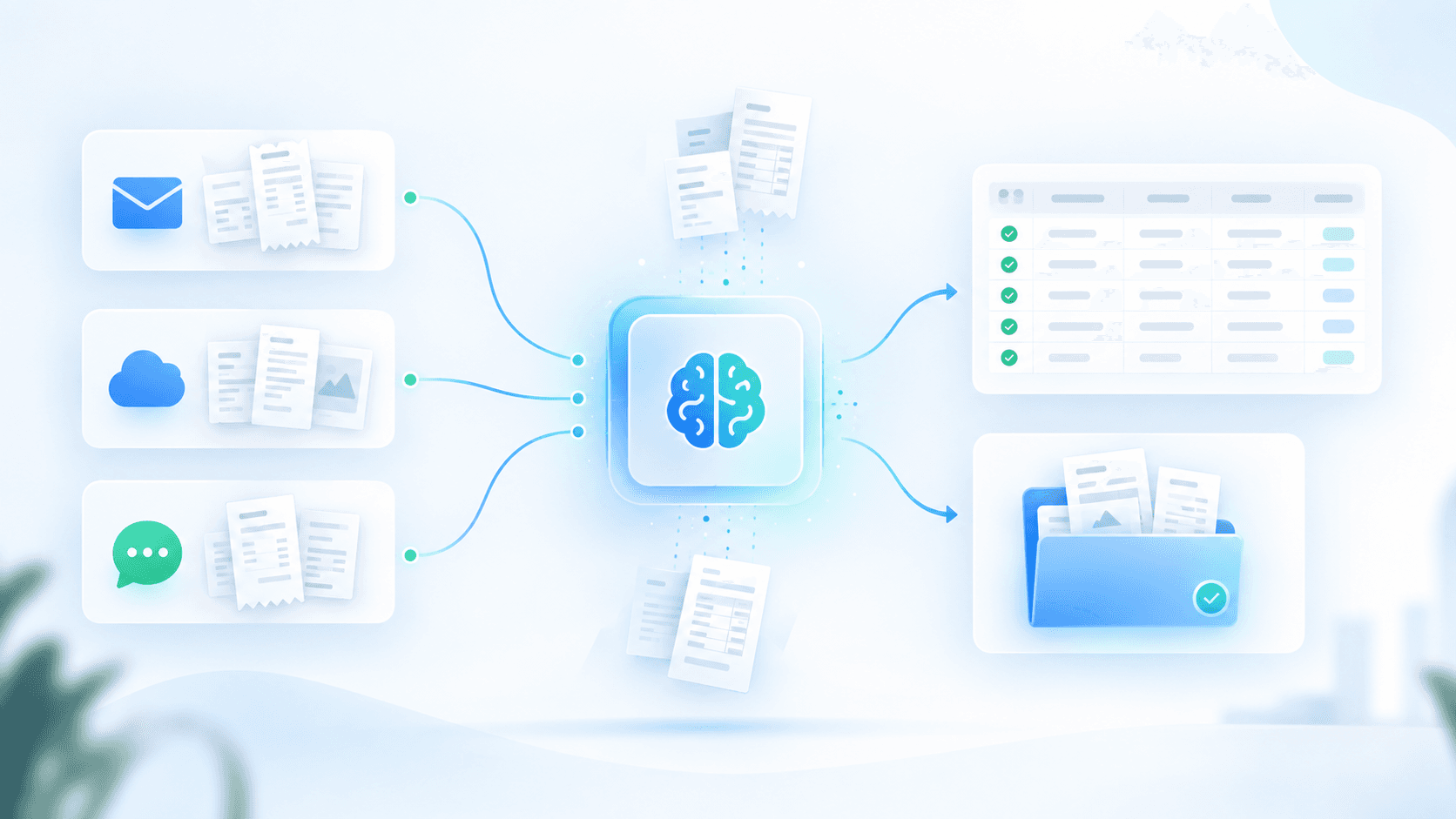
We built one intake and processing pipeline across Gmail, Google Drive, and WhatsApp.
Whenever a new receipt or invoice arrives, the system captures the original document and sends it through Gemini's vision capabilities to extract the structured information needed by the business.
But extraction is only the first step.
The workflow also:
- Normalises the extracted data into a consistent structure regardless of where the document came from
- Validates important numbers before anything is written to the accounting log
- Scores the result for confidence to decide whether it can continue automatically
- Logs high-confidence documents directly into Google Sheets
- Archives every original file in Google Drive for traceability
- Confirms successful processing back to the sender where appropriate
- Routes uncertain documents to a review queue instead of guessing
- Alerts the team in Slack when human attention is actually required
That last part was important.
We didn't try to remove humans from the process entirely.
We removed them from the documents where they weren't adding anything.
The outcome
- Documents from three different channels now enter the same workflow automatically
- High-confidence invoices and receipts can be processed without manual data entry
- Every source document is archived consistently instead of being scattered across inboxes and conversations
- Validation happens before extracted data reaches the financial log
- Uncertain documents are surfaced deliberately rather than silently introducing bad data
- The team reviews exceptions instead of processing every document
The result is a workflow where AI handles the repetitive work and people handle the judgment calls.
The goal wasn't to make document processing fully autonomous. It was to make human attention the exception instead of the default.
Got a bottleneck that looks like this?
Book a strategy call and we'll tell you honestly whether it's worth automating.
Book a Strategy Call